Latest Info on Egypt gov spend, Public Purchasing, Govt budget & Public spending
- Home >
- Public Procurement
Public Procurement in Egypt
Public procurement in Egypt is a foundational instrument through which the government implements public policy, delivers essential services, and executes large-scale infrastructure and development programs. Given the country’s size, population, and strategic regional role, government purchasing represents a substantial and continuous market for goods, works, and services.
The procurement environment in Egypt is governed by a unified legal framework and centralized institutional oversight. Public entities across central government, local administrations, and state-affiliated bodies rely on formal procurement procedures to ensure regulated competition, fiscal discipline, and standardized contracting practices.
For domestic suppliers and international firms, Public Procurement in Egypt offers access to one of the largest government tender markets in the Middle East and North Africa. Clear statutory rules, a national eProcurement portal, and defined complaint mechanisms provide bidders with a structured pathway to participate in government tenders in Egypt.
Country & Economic Overview
| Country | Egypt |
| Region | Middle East and North Africa |
| Population | 112.6 millon (2022) |
| Income Level | Lower middle-income economy |
| Currency | Yemeni Rial |
| Exchange Environment | Managed exchange regime |
| GDP | USD 476.75 billon (2022) |
| GNI | 455.14 billon (2022) |
| GNI per Capita | USD 4,100 (2022) |
The scale of Egypt’s economy and population creates sustained demand for public procurement across infrastructure, utilities, education, health, and public administration.
Public Procurement Governance Framework
The governance of public procurement in Egypt, Arab Rep is centralized under the Ministry of Finance, which plays a key regulatory and operational role in government contracting.
- Public Procurement Agency (PPA): Ministry of Finance through the General Authority for Government Services (GAGS)
- Institutional Role: Oversight, regulation, and coordination of public procurement activities
- Central Purchasing Body: The General Authority for Government Services functions as a national central purchasing entity
The central purchasing body covers a wide range of sectors, including agriculture, education, energy, health, transportation, water and sanitation, information and communication, and public administration.
Legal & Regulatory Framework
Public procurement law in Egypt, Arab Rep is primarily governed by Law No. 182 of 2018 and its executive regulations. This framework standardizes procurement procedures across public entities and establishes legally enforceable rules for contracting.
- Unified public procurement law applicable to goods, works, and services
- Principles of transparency, competition, and efficiency
- Legal provisions addressing sustainability considerations
- Statutory support for small and medium-sized enterprises
The law also provides for domestic preference mechanisms, bid securities, and mandatory public bid opening procedures to ensure procedural integrity.
Procurement Procedures & Thresholds
Procurement procedures in Egypt, Arab Rep are structured and regulated, with competitive tendering serving as the primary method for public contracting.
| Procedure Type | Application |
| Open Tendering | Standard method for most public contracts |
| Direct Contracting | Permitted under specific legal articles and conditions |
| Public Bid Opening | Mandatory under procurement law and executive regulations |
The legal framework regulates bid validity periods, advertisement timelines, and provides formal complaint mechanisms allowing bidders to challenge procurement decisions.
E-Procurement System Overview
Egypt operates a national electronic procurement portal that supports the publication and management of public tenders.
| System Name | Government Procurement Portal |
| Launch Year | 2007 |
| Ownership Model | Government-owned national platform |
| Core Functionalities | ePublishing, notifications, electronic tendering |
| Languages | Arabic, English |
| Supported Currency | Egyptian Pound |
The eProcurement system in Egypt provides public access to tender notices and allows suppliers to download tender documents electronically.
Procurement Market Characteristics
The public procurement market in Egypt, Arab Rep is broad and diversified, reflecting the size and complexity of the public sector.
- Large volume of goods procurement for public administration and services
- Significant works contracts linked to infrastructure and development projects
- Services procurement covering technical, professional, and operational needs
Domestic suppliers account for a substantial share of participation, while international firms are active in capital-intensive and technically complex projects.
Transparency, Complaints & Oversight
Transparency and oversight in public procurement are supported through legal requirements and institutional supervision.
- Defined complaint resolution mechanisms under procurement law
- Publication of tender notices and award information
- Availability of public procurement reports issued by the Ministry of Finance
These measures contribute to procedural accountability and provide suppliers with avenues for recourse.
Sustainability & Green Public Procurement
Egypt has taken policy steps toward integrating sustainability considerations into public procurement.
- Legal references to sustainability within procurement law and executive regulations
- Development of guidance tools and methodologies supporting sustainable procurement
- Alignment with national strategies on sustainable consumption and production
Future progress in green public procurement is expected to build on existing policy instruments and national climate and sustainability strategies.
Social & Ethical Procurement Considerations
Social and ethical objectives are addressed within the procurement framework through targeted legal provisions.
- Statutory measures supporting SME participation in public contracts
- Domestic preference provisions benefiting local suppliers
- Ethical conduct obligations embedded in public contracting rules
These measures aim to balance open competition with national economic and social priorities.
Key Challenges & Practical Insights for Bidders
Bidders seeking to participate in Public Procurement in Egypt should consider several practical factors:
- Complex documentation and compliance requirements
- Centralized oversight combined with sector-specific practices
- Strong competition, particularly in high-value public contracts
Successful bidders typically invest in understanding legal requirements, monitoring the Government Procurement Portal regularly, and ensuring precise compliance with submission rules and timelines.
Public Procurement in Egypt offers a large, structured, and regulation-driven market that rewards preparedness, compliance, and long-term engagement with public sector institutions.
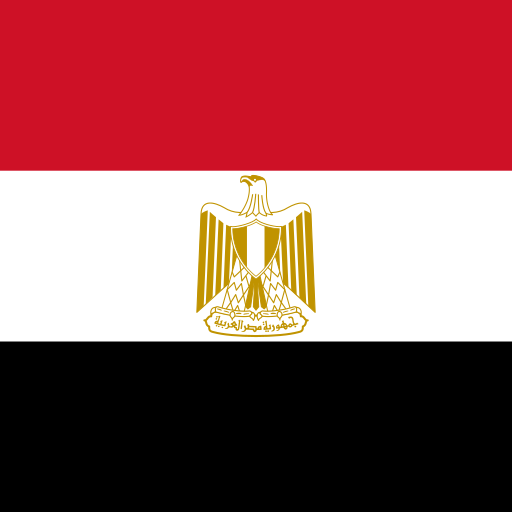
Flag of Egypt

Emblem of Egypt
Capital
Cairo
ISO 3166 Code
EG
Population
87,825,400
Area, Sq KM
1,001,450
Currency
Egyptian pound
GDP, Billion USD
2,71,973
Language
Arabic
GDP Growth Rate, %
2.2
Inflation, Avg CP, %
8.75
Interest Rates, %
-
Unemployement Rate, %
12.98
Exchange Rate, 1 USD Equals
7.62
International dial code
20
Time ZONE
GMT+02:00
Internet TLD
.eg
Get FREE SAMPLE TENDERS from Egypt in your email inbox.
Copyright © 2014-2026 EgyptRFP.com. All Rights Reserved.